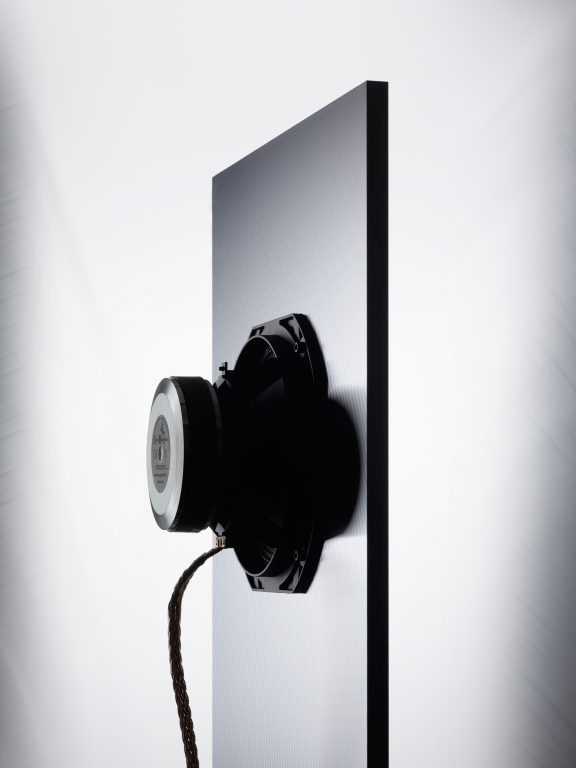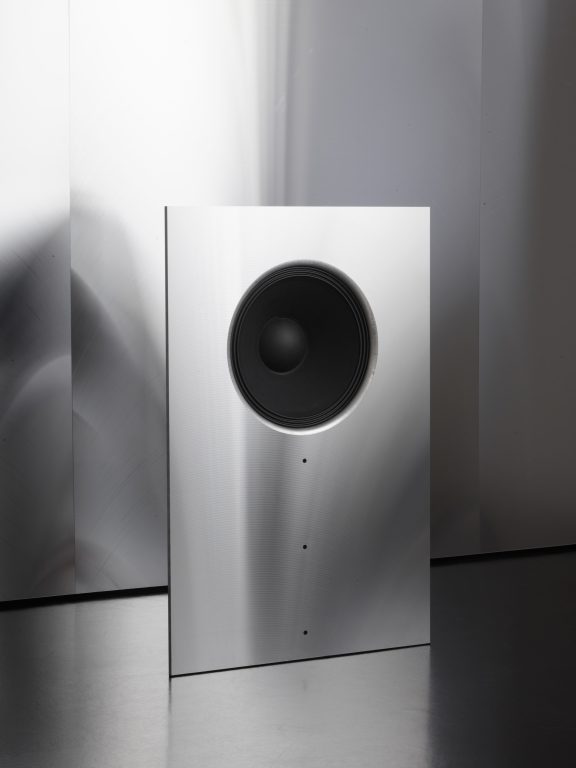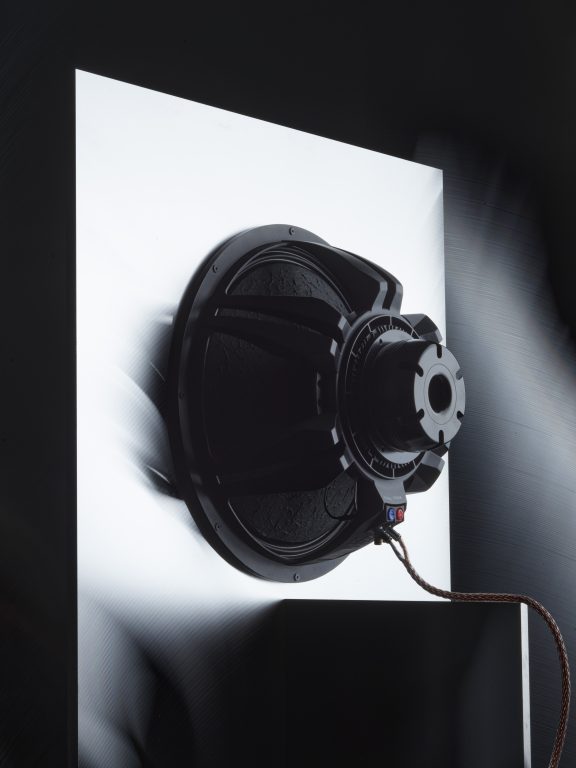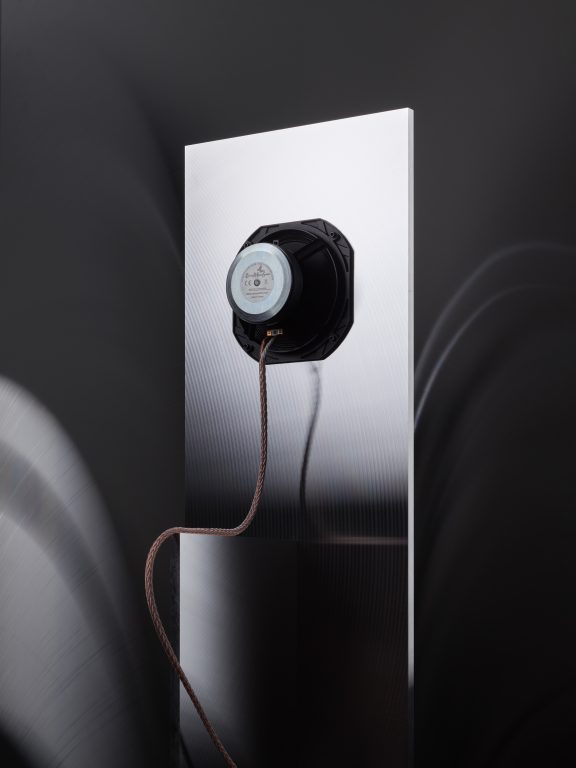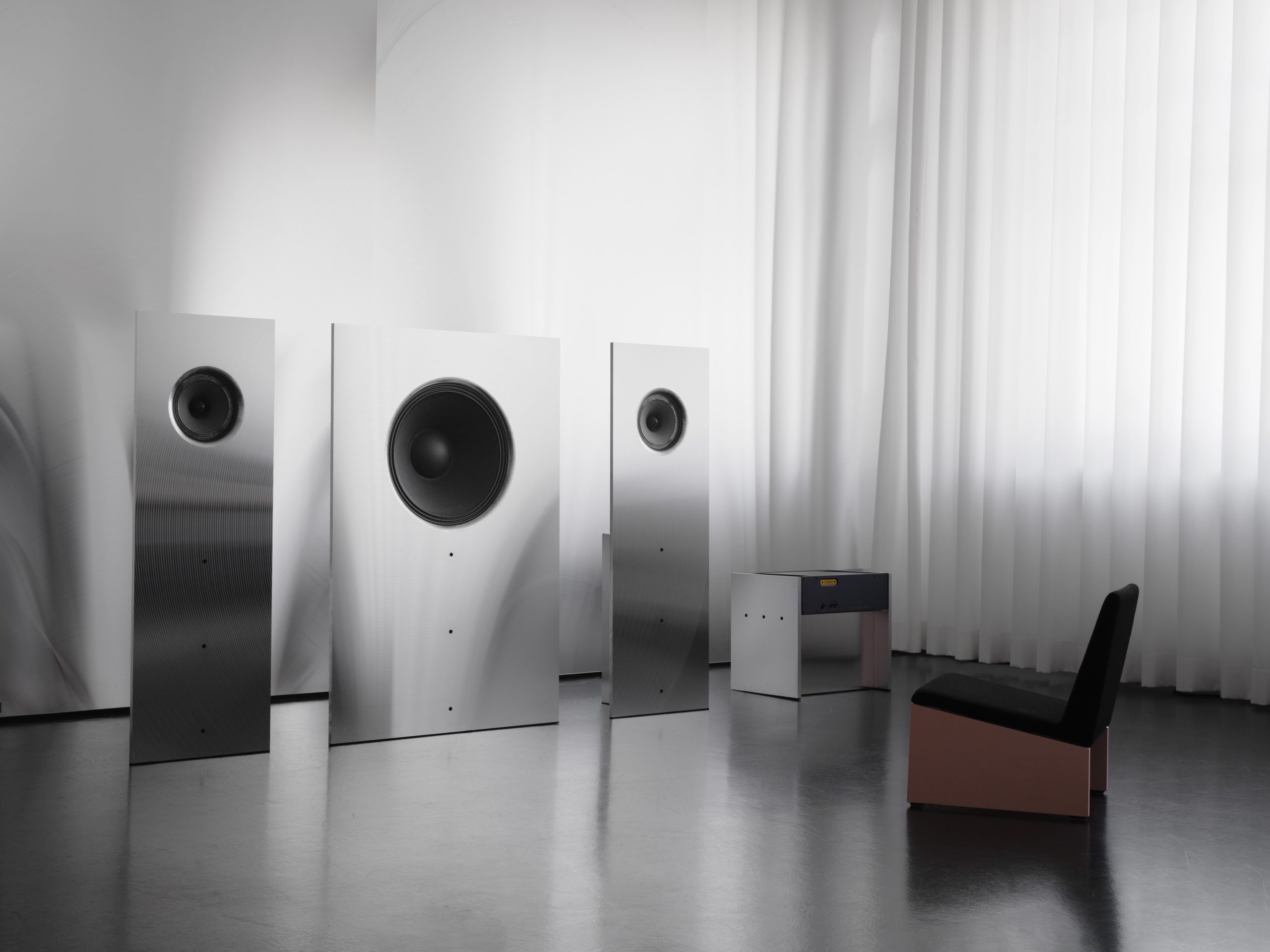
OPEN BAFFLE SYSTEM
This system follows the open-baffle principle: the drivers are not enclosed in conventional cabinets. They radiate forward and backward into the room, which tends to reduce “box character” and makes space, decay, and vocal presence feel unusually natural by minimizing enclosure resonances and stored energy that can blur transients.
The left and right channels reproduce the entire vocal and presence range without a crossover. A single wideband driver per side covers this region, avoiding the typical handover between multiple drivers and preserving continuity, timing, and spatial cues. This avoids the typical discontinuities and phase offsets introduced by multi-way crossovers in the most sensitive hearing range.
The size of the baffle, the selection and position of the drivers, and the overall placement are part of the acoustic design. In an open-baffle system these parameters directly shape radiation behaviour and frequency response, and have been defined through iterative measurements and adjustments to achieve a coherent transition between wideband driver and bass.
Because open-baffle speakers couple strongly to the room, the perceived balance, especially in the bass, depends more on placement and listening position than with typical box loudspeakers, although the current configuration is tuned to remain stable across small seat variations.
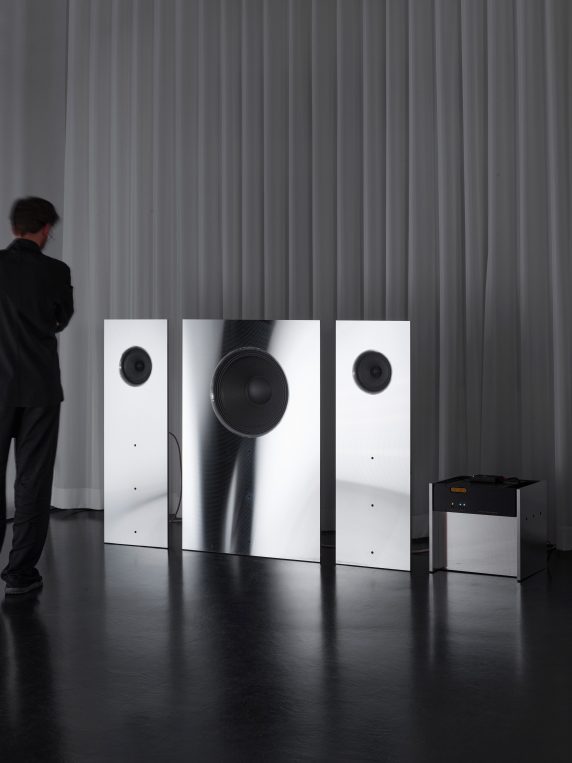
WHAT IT SOUNDS
Vocal presence with realism
Voices sound direct and clearly outlined, with a natural balance between chest, mouth, and consonants. The wideband driver covers the most sensitive part of hearing as one coherent source, which helps speech and vocals feel continuous rather than stitched. Presence stays clear without needing extra treble to feel detailed.
Fast attacks and clean decays
Percussion and plucked instruments have a quick, clean start followed by a clear and well-defined fade out. The open baffle approach avoids enclosure related overhang, so small dynamic changes and texture remain easy to follow, even at higher playback levels.
Space and depth, not just width
The stage is not only wide but also layered in depth. Near and far sounds separate well, and reverb tails read as room information rather than a flat halo. Imaging remains stable because the low mid region is well controlled and does not introduce strong masking or shifts in tonal body.
Bass with punch and texture
Bass is tight and physical, with good separation between bass notes rather than collapsing into a single emphasis band. The system delivers both weight and tone, so kick drum impact and bass instrument fundamentals feel present without masking texture. The low-frequency balance is consistent within a defined listening area rather than collapsing into a single optimal point.
Seat and placement still matter in the low end
Some bass notes still change slightly with listening position, which is typical room behaviour at low frequencies. The system is resolving enough to reveal these differences, but remains stable across small seat shifts, allowing subtle tuning of bass balance without changing settings.
CORE COMPONENTS
EMS path: Chord Hugo 2 RCA out → Chord SPM 1200C → EMS LB8 MKII (L/R)
Bass path: Chord Hugo 2 headphone out → Reckhorn A-410 → SB Audience NERO-18OBN500D (mono)
EMS LB8 MKII wideband drivers (Left and Right) From EMS (Electro Magnet Speaker), a French high-end driver manufacturer known for wideband and field-coil designs focused on coherence and microdynamic resolution. The LB8 MKII is a high-efficiency 8-inch wideband unit intended to cover most of the musical range from a single radiator per side, keeping the vocal and presence band on one driver rather than splitting it across a crossover. Values: ~8 Ω, ~93 dB (1W/1m), ~36 Hz–19 kHz, Fs ~36 Hz, Qts ~0.30.
Chord SPM 1200C power amplifier A high-power stereo amplifier with very high bandwidth and current delivery, designed to preserve transient response and low-level detail rather than adding tonal coloration. ~315 W/ch into 8 Ω.
SB Audience NERO-18OBN500D (mono open-baffle bass) An 18-inch open-baffle woofer designed for low-frequency output without enclosure loading. Fs ~22 Hz, Qts ~0.90, Xmax ~±16 mm, ~90.1 dB sensitivity. Operated up to ~150 Hz to remain non-localizable. Integrated via Reckhorn A-410 (gain, low-pass, phase, subsonic),
Chord Hugo 2 (DAC and master volume) Defines time-domain accuracy through FPGA-based reconstruction (WTA filtering). Emphasizes transient precision, microdynamics, and spatial stability. The system avoids DSP; tonal balance is shaped through placement, radiation behaviour, and analog bass integration.

SPL curve (Sound Pressure Level) This plot describes the system from a measurement perspective and serves as a verification of the perceived behaviour. It shows the frequency response at the reference seat (3.0 m / 850 mm), including room influence. The 1/12-oct curve reveals fine physical detail and interference structure. Multiple measurements confirm that the overall balance remains consistent across small position and height variations. ´The measured response confirms the intended balance: controlled low-frequency energy, stable midrange behaviour, and a presence region that supports clarity without artificial emphasis.

MATERIAL AND DIMENSIONS
The dimensions were not defined only as a formal or visual decision. In an open-baffle system, baffle size, driver position, and height above the floor directly shape radiation behaviour, low-frequency cancellation, and the transition between wideband driver and bass. These proportions were therefore established through iterative measurements and adjustments, as part of the acoustic design itself.
16 mm Aluminum cast plate EN AW 5083 (Al Mg 4.5 Mn 0.7) face milled on both sides
EMS baffles (left / right): 400 × 1200 mm (Driver center 952.5 mm from floor)
NERO bass baffle (center): 800 × 1200 mm (Driver center 835 mm from floor)